
This interview was originally published in French.
In this interview, Coralie Bijasson recounts her career change from ready-to-wear to home sewing, by way of writing sewing books. She talks about her vision to create sustainable and timeless designs for her patterns, discusses the challenges social media presents for self-employed individuals and the evolution of the online sewing community, and shares her current desire to find a less hectic pace after a busy year.
What prompted you to start a business?
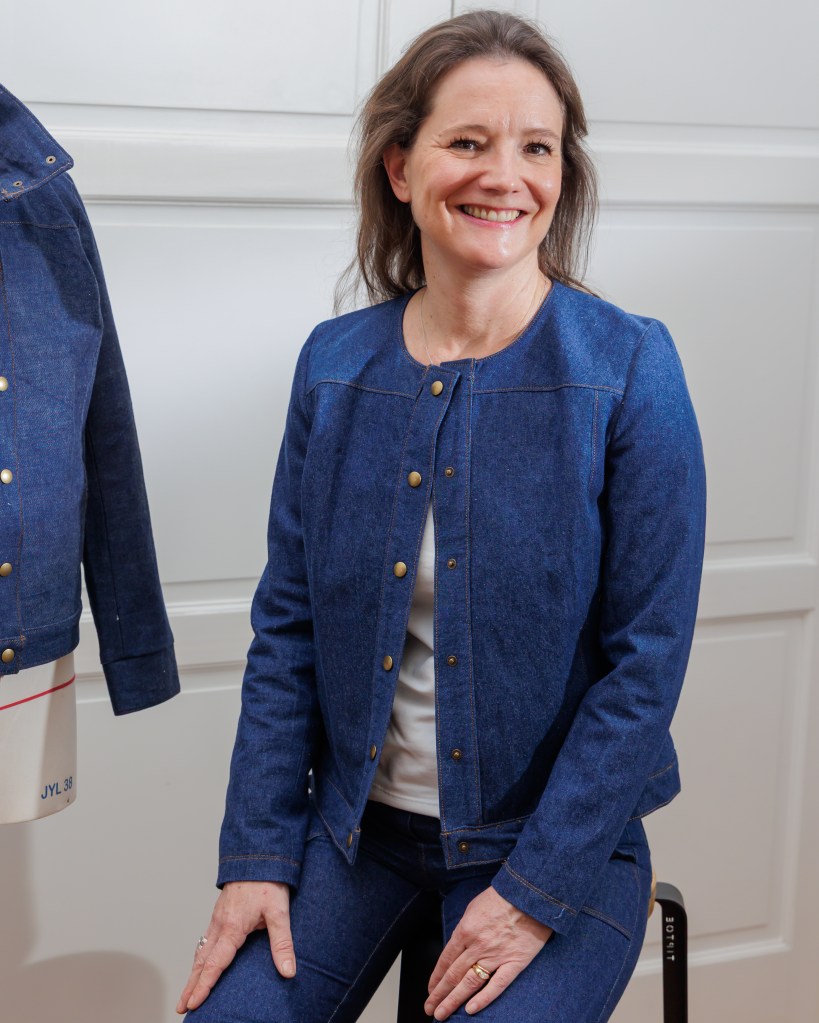
For me, it was a career change. Originally, I studied business and marketing. I worked in the ready-to-wear industry for ten years. I was a collection manager for a chain of stores called 1-2-3, now known as Maison 1-2-3.
I went back to school to study pattern making. When I graduated, Hachette offered me the opportunity to write a book. That’s how I got into sewing and crafting: through books. I wrote three books before launching my pattern brand. And now, I’ve written about fifteen, alongside my brand, ten of which I authored myself. The rest are compilations; it’s also a marketing thing for publishers. If you type my name into Amazon, about fifteen books come up.
And of course, the books were published under my name. Initially, I tried to have a different name for my pattern brand because it bothered me that it was based on my name. But customers didn’t understand at all. There was too much confusion between the books and the brand. Perhaps I persisted for too long with two names: people just didn’t make the connection.
So I simplified it: everything is called Coralie Bijasson. I still own my old brand, but I don’t use it anymore.
What are your favourite and least favourite parts of running a business?
Obviously, the design. You can’t get into it without wanting to be creative. The fabric, the search for the perfect shape.
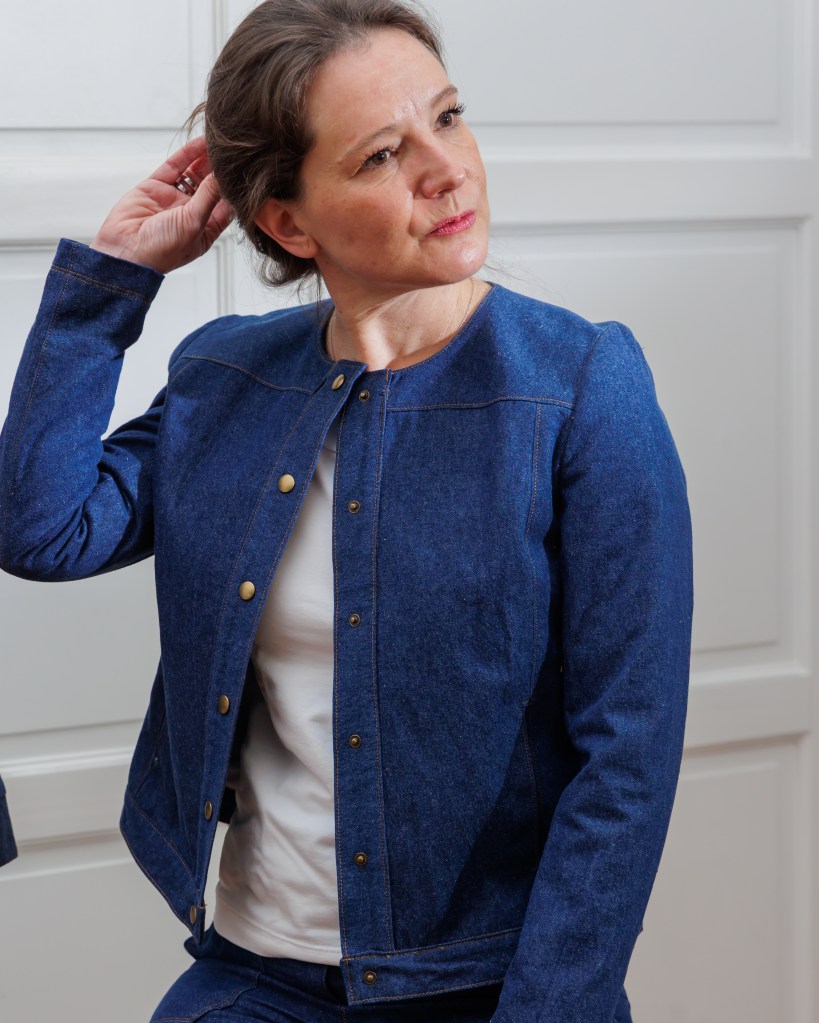
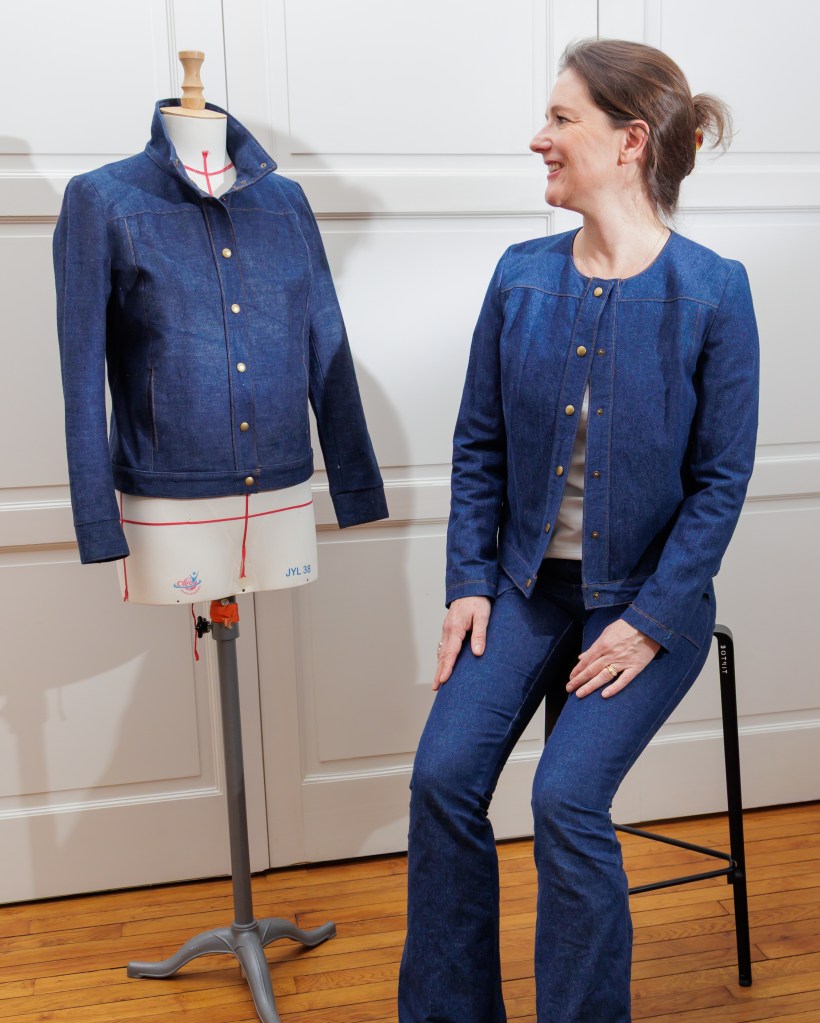
I make clothes that I wear. It’s really my own style. I don’t necessarily try to follow trends. I design a complete women’s ready-to-wear wardrobe. But no underwear, no swimwear… I want timeless, feminine fashion.
There are still some clothes I designed at the beginning, in 2014, that I wear today, and I’m thrilled to wear them. I really like the idea of something that lasts. There are a lot of basics that can be adapted depending on the fabrics. Many of my patterns are for everyday wear, because that’s what people want and wear. But there are also more sophisticated, more challenging, and more formal pieces. Some designs can also be adapted for special occasions. For example, I’ve created a few dresses that are more suited to weddings or evenings out.
What I like least: Social media. The feeling of always having to be online, having to talk about what I had for breakfast, lunch… I just can’t do it.
I’m 50 years old; I wasn’t born with social media. When I was an employee, there was a wall between my professional and personal life. Now, as a freelancer with a very small business, that barrier is hard to maintain. And of course, social media does everything it can to make sure we don’t maintain it anymore.
And then, I often work alone. At times, I’ve had apprentices or community managers, but right now I don’t have anyone. I find it incredibly frustrating to produce new content every day. Before, I felt like I had a much easier time establishing a presence on social media. So, we make a post, and nothing happens, or far fewer likes, questions, or interactions.
The sewing community has also grown enormously. The number of people involved, pattern brands, has increased significantly. At the last Créations & Savoir-faire trade show, there were over thirty of us selling patterns. Ten years ago, at my first CSF (Créations & Savoir-faire), there were only five or six of us. There are more and more of us, and to get noticed on social media, you have to dedicate a lot of time to it. Except I don’t want to. I don’t enjoy it, so I don’t do what I don’t enjoy.
And then, most people are very nice, but behind their computers, there are some who aren’t. We give a lot of ourselves, we present ourselves, we tell stories, and some people sometimes talk to us as if we were AIs. It’s dehumanizing.
What are your favourite fabric shops and haberdasheries?
In Paris, we’re lucky to have haberdasheries with a huge selection. I often go to the same ones: La Mercerie de Charonne and Fil 2000. It’s an Aladdin’s cave, with unbeatable prices, or at least prices that suit me. I sew about 150 to 200 garments a year. I also make patterns for different body types. I donate many of them to charities. So, my haberdashery budget is high!
I have trouble buying online. My job is very tactile. Pattern making is about shaping. It’s like baking a cake: it’s done with your hands. I need to touch the fabrics.
Today, I’m fortunate to have many partners who give me fabric. I still buy some, but most of it is given to me. At first, I went to less expensive brands because, coming from the manufacturing industry, my price frame was completely skewed. In the manufacturing industry, prices are on a completely different level. When I started sewing, I thought, “This is unbelievable, the price of fabrics!”
I go to Coupons de Saint-Pierre a lot: the quality-price ratio is excellent. In Paris, there’s also Bennytex, My Little Coupon… In the beginning, I went to Sacré Coupon a lot. My first books were all Sacré Coupon fabrics. They were among the first to upcycle fabrics from major brands. They have beautiful woolens, but it’s a bit pricey. If I’m sewing something for myself, then I buy it there. I treat myself!

Any other designers you admire?
I try not to look too closely. They’re part of my Instagram feed, it’s inevitable, but if you look at them too much, it’s stifling.
Before, I used to work six months in advance, releasing one design a month, on the first of the month. I stopped that about a year ago because it’s a crazy pace. And when you have a product ready to launch in two months, and someone else releases something similar, it’s so frustrating. But you have to expect it since, inevitably, we all work in the current trends. Unfortunately, the work is already done, paid for, so you’re not going to abandon it.
So I look, but from a distance.
When I started, there weren’t many of us: there was Atelier Scämmit, which was doing well, and Maison Fauve started at the same time as me. Now, I work with retailers, so I get feedback: certain brands often stand out for their quality, technical expertise, and the fact that the designers learn new things. I think people want to do something personal, to dedicate their energy to it, but they also want it to be educational, to learn something, to challenge themselves a little more each time.
Do you have any advice for someone who wants to start their own pattern-making business?
Don’t! There are so many of us, the market is completely saturated. I don’t know the American market, but in France, at the last trade show, there were so many of us. Making a name for yourself when you’re starting out must be really difficult now.
What are you most looking forward to in the future?
I’d like to find some peace of mind again. I put too much pressure on myself. Last year, I published a book with 18 patterns, plus my 12 collection designs, plus everything else. Because there’s so much competition, releasing a pattern also requires a lot more effort than before.
People want to see it in different sizes. Now, I try to showcase each design on different body types, to have variations so people can identify with it. When I release a design, I’ve made it about ten times.
That’s why I stopped releasing a design every month: I want to find peace of mind again. I was in a frantic race, always more, more, more. And I was starting to lose the joy, even though it’s a job I’m passionate about. It doesn’t make sense.
My goal this year is to find a good balance: passion, customer satisfaction, something peaceful.
 Replic: the blog