
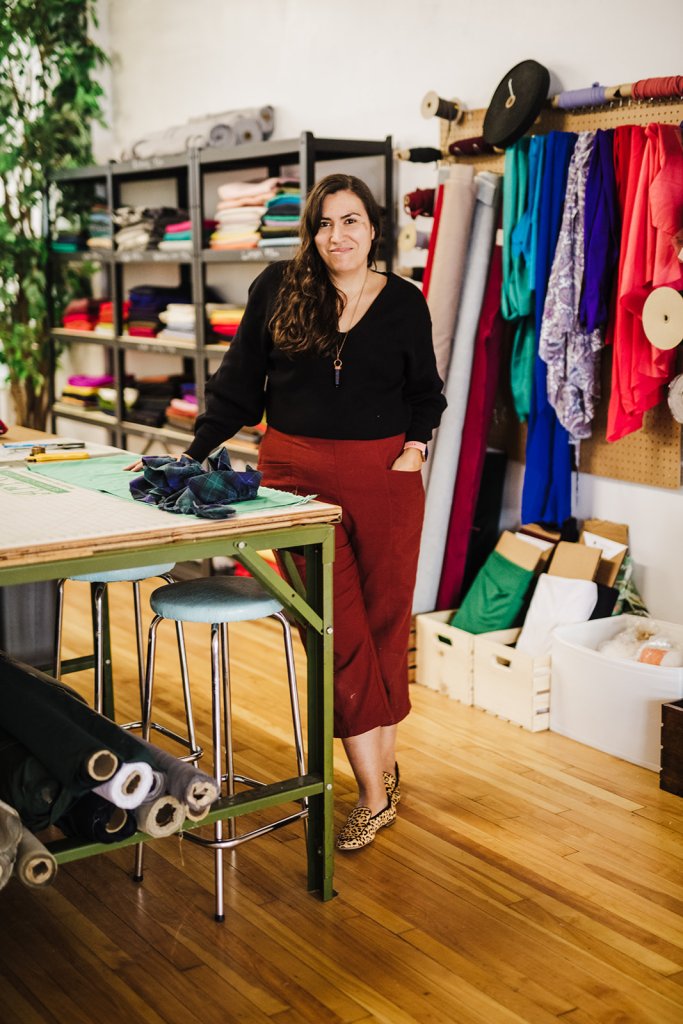
From fashion styling to sewing at home with young children and finally to building Empire Make Space, a community-centered creative business rooted in sustainability and making crafts affordable. In this interview, Ariane Clark reflects on the changes brought on by the pandemic, how deadstock fabric became the foundation of her evolving business, and why making space, both literally and environmentally, matters.
What prompted you to start a business?
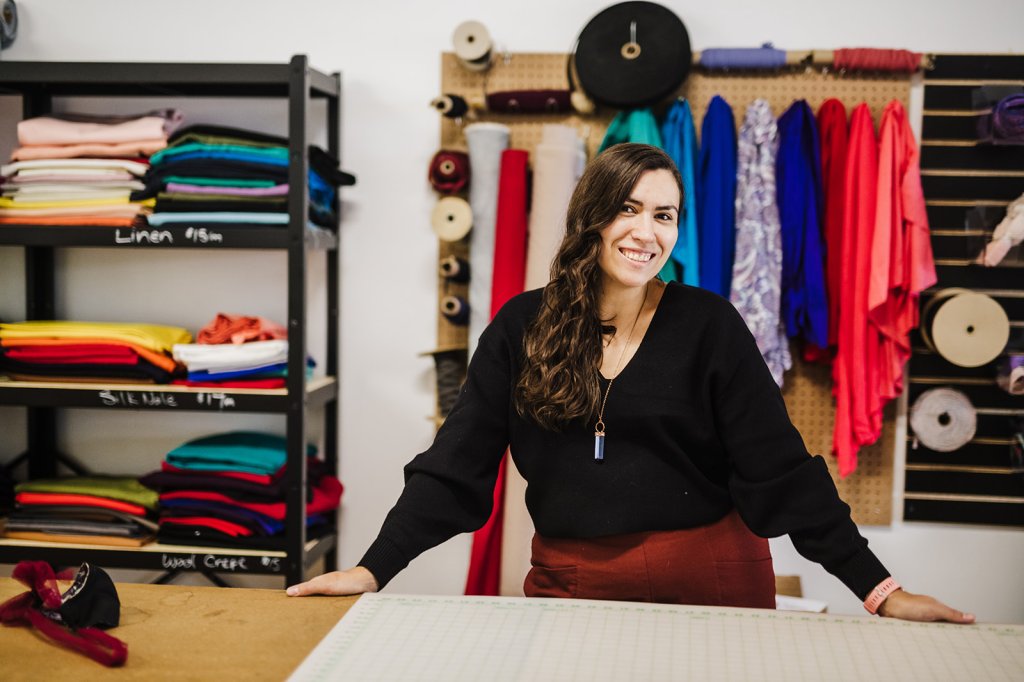
Initially I worked in fashion styling and wardrobe building. Then I had kids and fell out of that world. Since I was home with my kids, I got back into sewing. I had sewn my whole life but I never really worked with patterns before because fashion was a lot of hand-sewing and slapping things together for runway or for a shoot, not necessarily making something from the ground up.
I started getting into patterns and began making kids’ clothes. I started a small children’s line while my kids were babies, using vintage fabrics. I was upcycling before it was popular! I used vintage bed sheets and wool blankets and made little duffle coats. It was a cottage business. I sold at local markets, mom and baby shows, and Christmas markets. I was gearing up for bigger Canadian markets like One of a Kind trade show. Then COVID hit.
The world shut down. There were no markets, and at the same time I had been acquiring vintage and deadstock fabric to grow my business. My house was slowly filling up with fabric. With deadstock, you often have to buy entire lots, even if you only need a few rolls, so I had a lot extra. I thought “maybe I’d just sell it on Facebook Marketplace”.
Since there was no production happening, I initially thought about getting a small studio space outside my house to sell the extra fabric retail, and still have space to make my own work. I also thought about creating a small market-style store for local makers who had nowhere to sell their pottery, stained glass, or sewn goods.
During COVID, things opened and closed repeatedly. Sometimes we couldn’t have customers, sometimes makers couldn’t work at home and asked if they could sew in the studio as a coworking space. This is how the business grew. At the same time designers started reaching out with last season’s fabrics or factories needing to clear space. They told me “buy it or it goes to the landfill”. So I’d load up cars and vans and bring it back.
As for our fabric: some I pay for, some comes from designers who want it to go to a good home, and some is donated, from families of textile artists, people with full sewing rooms. We also have a lending library for books. Now we sell deadstock fabric, make products in-house, run workshops almost every day, and offer sew-by-the-hour space.
Where does the name Empire Make Space come from?
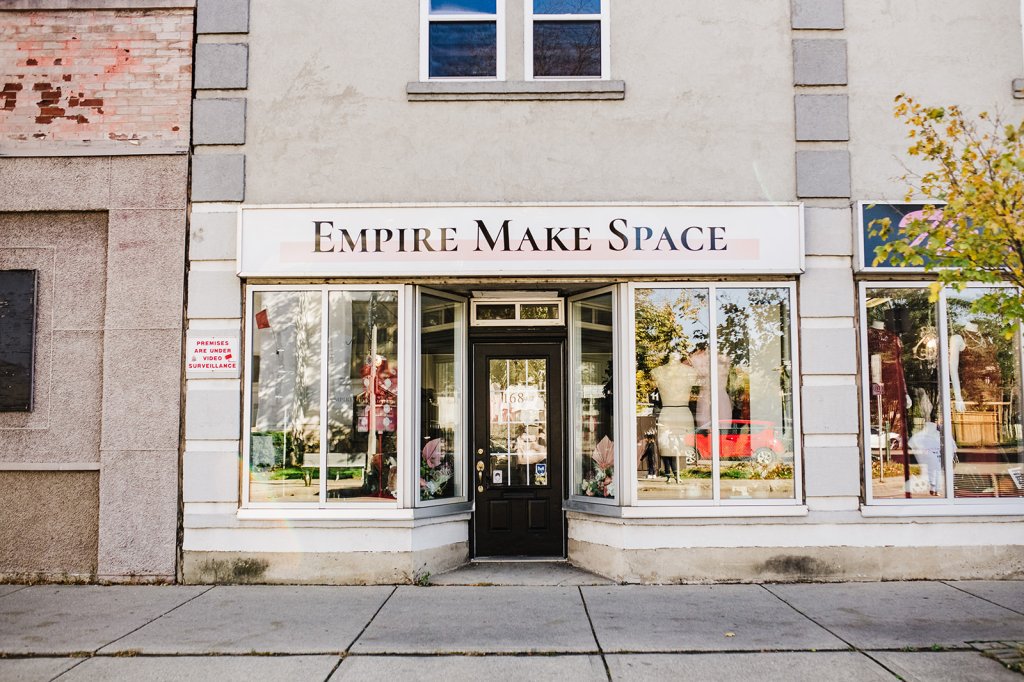
I really wanted to call it “The Makerspace,” but that was taken. I liked the idea of “making space,” because that’s what we do: we take fabric that would otherwise go to landfill and make something out of it. We’re making space environmentally and pushing back a bit against straight-to-consumer culture.
I’m an Elder Millennial and I loved the movie Empire Records. I loved the vibe of a community space with people from all walks of life coming together to make something. That’s where it comes from.
What are your favorite and least favorite parts of running your own business?
My favorite part is the flexibility. Sometimes that means working on the couch while my kids watch a movie at night, but I also get to take them to school, pick them up, and go to their concerts. That work-life balance is huge.
I also love helping people make things and giving them agency when the world feels out of control. Sewing can be expensive, so we try to remove barriers and make it accessible. Seeing someone light up and say, “I made that,” is really special.
The worst part is the admin: bookkeeping, emails. I thought I’d be sewing all day, but there are so many emails! I am always answering emails making sure teachers have what they need, classes are ready, details are covered. It can’t really be outsourced. You have to have your finger on every part of the business. It’s non-negotiable.

Who are your favorite sewing pattern designers right now?
There are quite a few newer designers I’m liking. Syd Graham Patterns is one. There’s been a shift from sewing bloggers to sewing YouTubers. Some have great videos but weaker written instructions.
I’d say the gold standard is still Helen’s Closet, Closet Core, and Friday Pattern Company. But there are newer makers coming out with really well-thought-out instructions, both written and video, and I’m enjoying that shift.
Are there any stores or spaces you admire?
I really love other makerspaces. The Sewing Club out in BC has a great vibe. In Hamilton, there’s Main Fabric and Hamilton Craft Studios. The latter doesn’t sell fabric but they do workshops and maker events.
I also love Makerspace Sellwood in Portland. They offer workshops in sewing, embroidery, clay, letterpress, and then sell the work made by the person who taught the class. I love the idea that you can either buy the object or learn to make it yourself from the maker.
What advice would you give to someone considering opening a store?
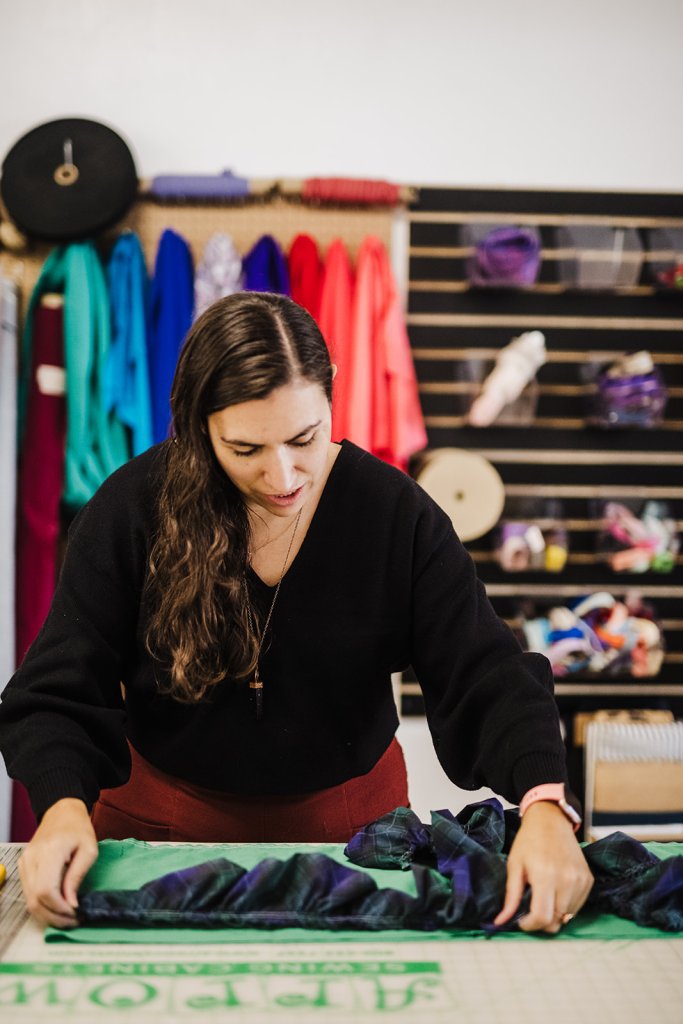
Just do it. The time will pass anyway. If it doesn’t work out, you’ll do something else after. Start as organically as possible. People often want to go big right away, but starting small means less stress and less risk of failure.
What are you most looking forward to?
I’m interested in expanding in different ways. Opening during COVID made me really resilient. Every week was a new pivot. I love the idea of wholesale digital patterns, kits, and something like a craft café where people can grab a project and just sit down and make it with no barriers.
We’re stocked with fabric. Probably enough for a lifetime! I’m excited to get more people sewing, with no barriers.
 Replic: the blog