
Tereska Gesing was pulled into heading yet another business, Core Fabrics, by Heather Lou, long-time friend and founder of sister-store Closet Core Patterns. In this interview, Tereska shares the joy of collaborating and working with a team, bemoans the conflicts faced by all business owners wanting to offer a full-range of products while staying mindful of cashflow, and discusses upcoming projects for the store including a wholesale range and an exciting textile circularity program.

What prompted you to start a business?
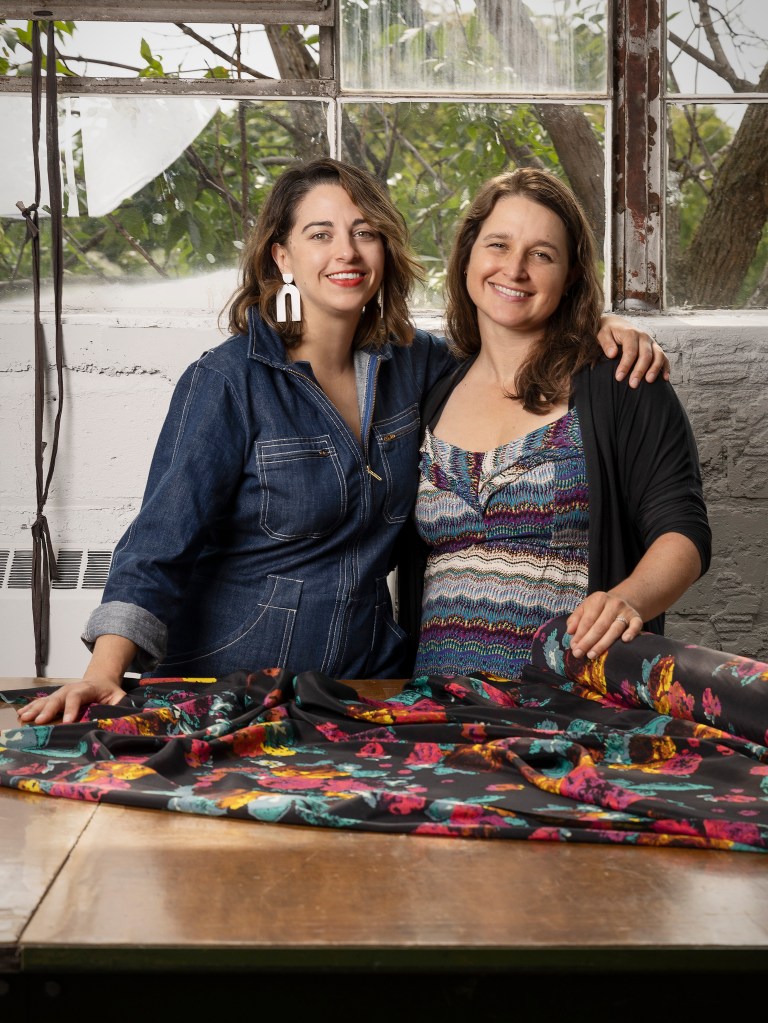
My friend Heather called me up during the pandemic and said, “I’ve always wanted to start a fabric store”. She had great success with her other business, Closet Core Patterns, but she was having trouble finding eco-responsible, high-quality garment fabric that was available in small enough quantities to sew one piece of clothing. In the struggle of trying to find the fabric she wanted for sampling her patterns and sewing her own clothes, she wanted to start a fabric store. She told me, “Tereska, I want to do this, but I’m not going to do it unless you run the company.” So here we are.
Heather and I met as teenagers in Windsor. I went to high school with her cousin Jessica. And then I kind of convinced her to move to Montreal in her early twenties. Then we got up to all sorts of trouble in Montreal.
Where does the name Core Fabrics come from?
We wanted a clin d’oeil to Closet Core Patterns (ed: “a nod” in English but the French call it “a wink”), but also we wanted to talk about getting back to the basics of natural fibers and the staple fabrics you need to make a wardrobe.
What are your favorite and least favorite parts of running a business?
The least favorite would be managing cash flow, especially in an inventory business where you need to buy product to sell product. There’s a tension between wanting a beautiful palette of colours, a full range of fabrics, and following Heather’s wonderful artistic vision, while making sure we don’t buy so much inventory that we’re spending more than we make. It’s a constant struggle. The money part is a real drag, but that’s what I signed up for.
The favorite part: I’ve tried to do other things in my life, but I always come back to starting businesses or organizations. I find the act of creating something I can look back on and say, “Look how big it’s grown,” very satisfying. Building something that didn’t exist before, bringing a team together who know so much more than I do, setting the direction and vision, and making sure we’re all rowing in the same direction… It’s very stimulating, engaging, and creative.
Any favourite sewing patterns or designers?
My dirty secret at this phase of my life is that I don’t actually sew very much. I do know how to sew. I did a fashion design degree. My very first business back in 2008, which was a horrible fit for me, was designing and making wedding dresses. Heather got me back into sewing my first garment for myself since 2003, which was her first Crew Pattern jacket, the Parchment Jacket, a quilted coat.
I can’t really talk about patterns, but my favourite pattern company outside of Closet Core is Cashmerette. Jen is a wonderful collaborator. We do fabric kits for their patterns from time to time, and I really enjoy working with her and her team. They started from a really strong position of body positivity and sewing for bodies that have a hard time finding ready-to-wear clothes. I love how positive the messaging is and how much they’ve empowered women to feel great in the body they’re in.
Are there any other stores you admire?
I really admire Stone Mountain & Daughter, a fabric store in the U.S. I’d love to meet the owner, Suzan. She’s built a really strong online presence and a physical store that’s deeply connected to the community in Berkeley, California. It feels like a place where customers are part of something. It’s not just transactional.
Do you have any advice for people considering opening a store?
Entrepreneurship is probably the worst possible way to make money. The people who are good entrepreneurs are the ones who have to do it. The people who need to drive the ship, make decisions, take risks. If you want stability, it’s easier to be an employee, and we need great people on teams.
But if you’re someone who sees a hole in the market and needs to fill it, the most important thing is to reflect deeply on what problem you’re solving. Validate that it’s a real problem other people have. Know who you’re solving it for. If you lose sight of that, you become invisible. But if you have a strong, clear vision of why you’re doing what you’re doing, the people who need you will find you.
What are you most looking forward to right now?
We’re moving warehouses, which isn’t very sexy, but we’re doubling our space and adding an event space. That will let us host in-person events, which has been difficult in the past.
We also started wholesaling fabric this year in response to changes in the U.S. market. A majority of our clients were in the U.S., and the wholesale department helps us increase our local market opportunities. What surprised me is that many of our wholesale customers are small fabric stores. I didn’t see that coming. I’ve developed an offer for small fabric stores that I think is very innovative in this hybrid online-in-person world, and I’m excited to test that idea at the upcoming H+H tradeshow.
Finally we launched a textile circularity program in September 2024, our deadstock program, where we buy leftover textiles from local designers. So far we’ve collected about 60,000 meters of fabric that would otherwise sit unused or go to landfill.
The next challenge is textile scraps. There’s no large-scale textile recycling in Quebec or Canada, but there are small businesses that recycle specific fibre types. We want to create a collection network so designers can drop off scraps, and we manage the logistics to get them to the right end users.
Textile waste is a massive problem. We can’t solve it, but we can take a small step. We’re working with Fashion Takes Action and using software that tracks fibre composition so scraps can be properly reused. We just received funding from Fonds Écoleader to evaluate the project. It’s still exploratory, but I’m excited to see where it leads.
 Replic: the blog