
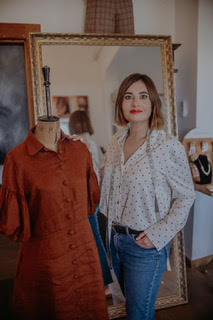
Originally from Cape Town and now deeply shaped by life in rural Namibia, Mari-Leen’s journey into pattern making grew from boredom, a belief in the power of sewing for yourself and a love for online learning. With a keen eye for trends, she built a business rooted in creativity, experimentation, and global connection. Mari-Leen is now working on a line of pattern blocks to become the next foundation of her evolving sewing pattern brand Pattern Sewciety.
What prompted you to start a business?
I’m originally from Cape Town, South Africa, and in 2011 I got married to a Namibian sheep farmer. I live very much in the middle of nowhere. Namibia is already remote, but this is the rural side of it, really the middle of the middle of nowhere. If you had passions you’ve never really pursued, this is the place where you find out if you actually like them or not.
I was always really into fashion, but I studied psychology, and I also did beauty therapy after school, if you can believe that. When I came to live here, online learning really started becoming a thing. I always thought that the ability to make a clothing pattern must be the greatest skill anyone can have, to see a photograph of a piece of clothing and be able to recreate it.
When platforms like Craftsy became available, I took my first pattern design course and I was absolutely hooked. Then I started discovering PDF patterns and I just thought, this is the most wonderful thing I’ve ever encountered. I have to do this. I later did Lauren Doll’s pattern workshop course, and the rest is history. So honestly, my business came from boredom and a real love of online learning.
Where is the name from?
Honestly, I can’t remember where the idea came from. It just came to me, and I thought it was nice. Sewciety is obviously a nice wordplay, but I don’t really have a strong backstory behind it.
What are your favorite and least favorite parts of running a business?
That’s very easy to answer. My least favorite part is social media. The pressure to be consistent all the time can completely break me, sometimes for months. It just feels like too much.
My favorite part is definitely the design aspect. I’m a fashion designer, and creating a new design is the best bit: testing it and ending up with a great product afterward. I also really love working with an international group of people on every pattern. That’s actually one of my favorite parts as well.
Favorite fabric stores?
Mostly South African ones. In Cape Town there’s a beautiful fabric store called Lively Fabrics. They have many Spanish-inspired prints, which I really love. In Johannesburg, I usually order online from a place called Moosas. And if I’m ordering internationally, I actually like buying fabric on Etsy. You can find really nice things there. It’s quite a safe platform for fabrics, especially if you are looking to buy Chinese fabrics directly from manufacturers.
Any other pattern designers you admire?
I really like Russian pattern designers, like Vikisews and Grasser Patterns. Their designs are much more fashion-forward than most pattern brands. I find that many pattern brands cater to a more neutral design aesthetic, but I’m more into ruffles, textures, and slightly trendier styles. They really cater to that taste, so I always recommend checking them out.

Any advice for people considering opening a pattern brand?
Don’t quit your day job! That’s my first bit of advice. That’s a joke, but also kind of not. There’s a lot of competition now, especially with AI patterns entering the market, so it is very competitive. I wouldn’t say don’t start, but I do think starting it as a sideline first is good advice, at least in the beginning.
What are you most looking forward to?
I’m very excited because I’m moving back to South Africa next year. I want to establish myself there as a fashion designer, and I’m currently testing a pattern block set: a basic base, a top, and a skirt. I want to change the whole model of my business.
Instead of releasing a brand-new pattern every time, I want to base all my designs on a pattern block. In the end, I’ll mainly sell the blocks and then share videos showing how I create new designs from them. I’ve found that you can spend a lot of time and money on a design that just doesn’t sell, and this way, if it works, it works and if it doesn’t, it doesn’t.
I come up with new designs frequently, but the time it takes to fully set up a pattern is just too much to keep up with. I feel this approach makes my designs more accessible. At first, I wanted to be beginner-friendly, but most of my customers aren’t beginners. They understand patterns and just want the designs. If you have the right pattern block, adjusting it is usually a very simple process.
 Replic: the blog