
The original interview was written in French, you can find the original text here.
In this interview, Sarah Bernier, founder of Les Perlines, recounts how her dream of a career in the fashion industry was transformed when she discovered the world of PDF patterns, a revelation that completely redefined her path. She shares her deep love for pattern development, the challenges of having too many ideas and not enough hours to bring them all to fruition, and the often laborious reality of building your own business.

What prompted you to start a business?
Originally, I studied fashion design, and my goal was really to work in a company: a 9-to-5 job. During my bachelor’s degree, I did a six-month internship at Reitmans, in the maternity department. I worked as a design assistant. After the internship, they offered me a job. But after about a year, I realized it was really repetitive. I was lost. I was so sure I wanted to work in a company, but reality didn’t match what I’d imagined.
People don’t realize that the corporate fashion industry is very different from sewing at home. They’re two completely different worlds. Even after six years of study, I hadn’t encountered this world. It was by chance on Instagram that I stumbled upon a PDF pattern company, and I thought, “Oh my God, being a pattern maker is what I’ve always dreamed of doing!”
In a company, people prefer to be designers rather than technicians. It pays better. And when you’re a designer, you don’t really work with patterns anymore. When I discovered, in 2018, that there were designers making PDF patterns for people who sewed at home, I started thinking about creating my own patterns almost immediately, and I finally released my first pattern at the end of 2020. It took time.
Where does your company name come from?
“Les Perlines” is an old nickname for girls. In my family, my grandmother called herself and her sisters “les perlines.” She also called my aunts that, and sometimes my father affectionately called me and my sisters “les perlines.”
I knew most of my content would be in English, so I really wanted to keep a French name. And I didn’t want it to be my own name. “Les Perlines” is an ode to my family. Especially since it was my grandmother who taught me to sew.
Favourite and least favourite parts of running a business?
My favorite part is definitely development. When I have an idea, making prototypes, solving fit issues, thinking about how to assemble it, how to write the instructions so they’re as clear as possible. I want the experience to be fun for all my customers. During my bachelor’s degree, we were encouraged to find more creative ways to finish garments and approach design. That really made an impression on me. Seeing problems and finding solutions is also what allows me to grow as a designer.
What I like least is how time-consuming it is to create a pattern. I have so many ideas. I’ve been working full-time for a year now, and I thought I’d be able to release all the patterns I have in mind, but no. The hardest part is choosing which designs I’ll have time to make. I love doing research and looking at trends, which means I have 40,000 pattern ideas every week. I have about ten patterns, so creating a cohesive collection while also releasing new ones is difficult. I want to do everything, but I’m short on time.
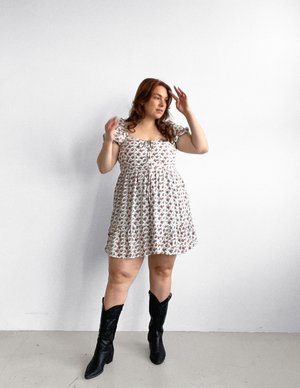
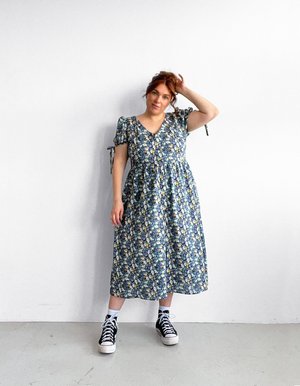
Do you have any favorite fabric stores?
I buy everything online. My number one fabric supplier is Blackbird Fabrics. The quality is always top-notch. And they’re based in Canada, like me, so there are no surprises with import fees.
My online shopping routine involves browsing all the sites and looking at all the fabrics. I add everything to my cart and then close the page. I don’t really keep a stash. I’m short on space and I prefer to buy for each project.
Are there any pattern designers you admire?
There are so many. I rarely make other people’s patterns. It’s not because I don’t admire them, it’s just that if I have an idea, I want to develop it myself.
What advice would you give to someone who wants to start their own pattern business?
I would say take it slow. My first pattern came out in 2020, and I’ve only been working on it full-time for a year. I worked on it for four years on the side, more than part-time. You have to take your time, build a solid foundation.
A lot happens through social media, and someone new to this might think, “I’m going to release a pattern, it’s going to be a huge success, I’m going to get rich instantly, and I’m going to quit my job.” But that’s rarely the reality.
It takes time to build a business, an audience, a market. And that time also allows you to hone your skills. Pattern after pattern, I built my system. I perfected my methods, my instructions, my tiered approach. If everything doesn’t have to be perfect at the beginning, it takes the pressure off.
Of course, working two jobs for four years is demanding, but I’m passionate; I would have done it anyway.
What are you most looking forward to?
I have so many patterns I want to make; I just want to create, create, create. I have other projects too, but my priority is to empty my mental bank of ideas. I don’t know if it will ever happen, but that’s what excites me the most. Creativity, for me, is an endless well. If I stopped doing this, I would do a thousand other projects: pottery, woodworking, DIY projects. Once you get going, it’s endless.
 Replic: the blog